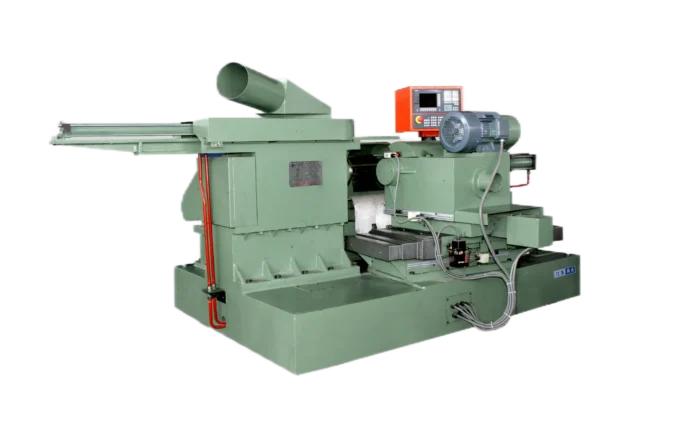
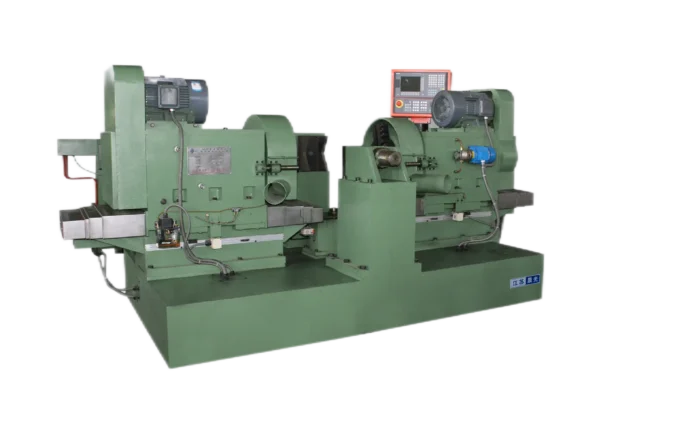
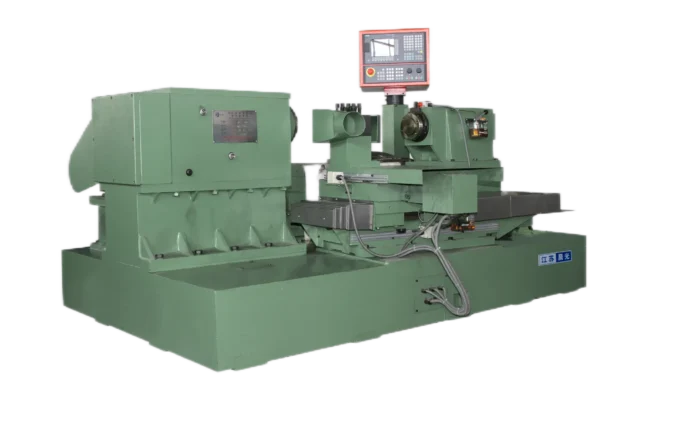
CGK·RZ·01 Graphite Nipple Flexible Auto Processing Line
Eight Stations, One Coordinated Line
The CGK·RZ·01 is built for carbon plants producing graphite electrode nipples — the most stressed component in the electrode column, where a thread off by hundredths of a millimetre can concentrate current and trigger breakage.
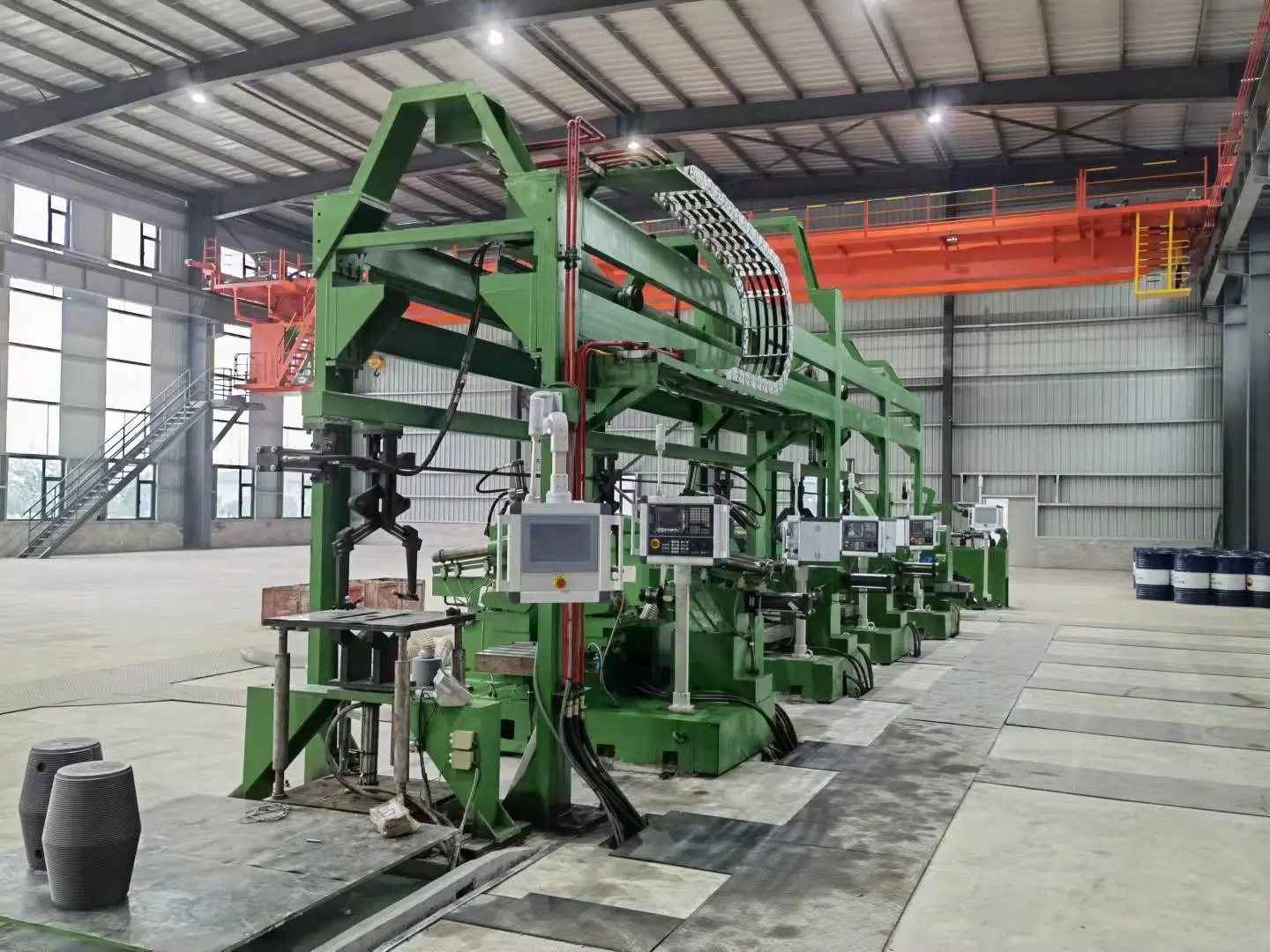
A graphite electrode nipple is the most stressed component in the electrode column — it carries the full furnace current, sometimes above 100,000 amperes, through a threaded joint narrower than the electrode itself, and a thread off by a few hundredths of a millimetre concentrates current and triggers breakage. The CGK·RZ·01 machines nipples across eight automated stations — from cut-off through thread combing to final weighing — with inline resistivity and elastic modulus measurement that verifies every nipple before it ships, and micron-level X/Z motion control (0.001 mm pulse equivalent) that holds the thread geometry the Ideal Connection theory demands.
Request a Line Layout →Key Features & Working Principle
Six capabilities that a collection of standalone nipple machines — a saw, a lathe, a thread mill and a manual inspection bench — cannot match.
Eight-Station CNC Networking
All eight stations — cut-off through weighing — run as one coordinated flow, so a nipple moves from raw stock to inspected, weighed, certified component with no manual hand-off.
Inline Resistivity & Modulus Inspection
Every nipple is weighed and measured for resistivity and elastic modulus inline — 100% checked, not sampled — so an out-of-spec part is caught before it ships.
Remote Diagnosis & Real-Time Monitoring
Remote access and live image monitoring let a technician diagnose faults and clear alarms in minutes — no waiting for an on-site service visit.
Micron-Level Thread Motion Control
X/Z axes run at a 0.001 mm pulse equivalent — one micron — holding thread profile and taper at international-advanced level, where coarser resolution bakes in pitch error.
Flexible Specification Adaptation
Type I and Type II nipples across RP, HP and UHP grades run on one line via programmable profiles — changeover means loading a program, not re-tooling.
Ideal Connection Theory Applied
Every station is tuned to maximise nipple-to-socket contact area, cutting joint resistance and the localised heating that drives oxidation and nipple failure under thermal cycling.
Why Choose the CGK·RZ·01
Against standalone machines linked by manual handling and sampling inspection, the CGK·RZ·01 wins on traceability, thread integrity and lifecycle cost.
Eliminates Handling Damage
The line removes every manual hand-off and links quality data to each nipple by sequence — eliminating the handling damage and tracing gaps of standalone setups.
100% Inline Defect Catch
Each blank is probed for resistivity and modulus before machining and rejected if out of window, so defects never consume machining time or reach a customer.
Breaks the Joint-Resistance Loop
A 0.1 mΩ joint-resistance rise at 100 kA dissipates ~1 kW of heat — micron-level motion control holds the geometry that breaks that failure loop.
Runs Unmanned Shifts
Remote diagnosis and live image monitoring resolve alarms and tune tool changes from trend data, keeping the line productive through unmanned shifts.
Lower Total Cost of Ownership
A cheaper standalone setup hides labour, scrap and rework costs the integrated line eliminates — over 3–5 years, total cost favours the line.
Export-Grade Traceability
Automatic recording compiles a printable certificate linking each nipple to its raw lot, resistivity, modulus and dimensions — meeting international steelmakers' traceability rules.
CGK·RZ·01 — Technical Data
Main technical performance indicators from the factory datasheet.
| Parameter | Unit | Type I | Type II |
|---|---|---|---|
| Machined Nipple Diameter | mm | Φ120–Φ431 (for Φ200–Φ800 mm electrode) | Φ241–Φ488 (for Φ450–Φ900 mm electrode) |
| Machined Nipple Length | mm | 177–635 (for Φ200–Φ800 mm electrode) | 241–685 (for Φ450–Φ900 mm electrode) |
| Single-Thread Pitch Error | mm | ±0.015 | ±0.015 |
| Cumulative Thread Pitch Error | mm | ±0.025 / 150 mm | ±0.025 / 150 mm |
| Thread Hole Taper Tolerance | ″ | ±20 | ±20 |
| Thread Half-Angle Error | — | 30° ±10′ | 30° ±10′ |
| Double-End Thread Four-Point Deviation | mm | ≤0.04 | ≤0.04 |
| Effective Diameter Error | mm | ≤0.05 | ≤0.05 |
| Z-Axis Pulse Equivalent | mm/pulse | 0.001 | 0.001 |
| X-Axis Pulse Equivalent | mm/pulse | 0.001 | 0.001 |
| Cycle Time per Piece | min/pc | Large 3 / small–medium 2 | Large 5 / small–medium 3 |
Materials & Industries Served
Designed for carbon plants supplying graphite electrode nipples to steelmakers running electric arc furnaces — where joint integrity is a production and safety determinant.
Frequently Asked Questions
What is a graphite nipple auto processing line?
What stations does the CGK·RZ·01 include?
How does inline resistivity and elastic modulus measurement work?
What is the pulse equivalent and why does it matter for thread precision?
What nipple types and specifications can the line process?
How do I specify and order a CGK·RZ·01?
Configure a CGK·RZ·01 for Your Nipple Plant
Send us your nipple specifications, electrode grades, resistivity and modulus targets, daily throughput, quality certificate requirements, and workshop layout — including floor space, power supply and network infrastructure for remote monitoring. Our engineering team will prepare a line layout with confirmed specifications, cycle-time estimate and quotation.
Request a Quote →